Tuesday, 21 February 2023

Dawn and embodiment

A little clip of the rehearsal process for Dawn solo from Coppelia (video starts at 45 seconds)

As I embark on this first stage of 2023 I am busy in a number of areas. Currently rehearsing for Coppelia and preparing to dance The Dawn and Prayer solos. Allowing myself to become emersed in this concept of dawn and how that translates to balletic performance. The feeling of new light, new beginning, awakening and illumination. It feels enriching.

Yet as I seek to embody these concepts through movement, I am simultaneously challenged by the ethical considerations of a ballet environment. Pointe work for example involves some degree of unavoidable pain. How do we convey this to young people as they begin to dance, how is it ethically right to be doing ballet in the first place? 
Considering this notion of the ethereal woman which ballet has evolved from. Am I wrong to be part of this system when there are so many aspects I disagree with? These are just some of the questions floating around in my head at the moment. I have always wanted to use ballet to help people but I am part of a system which one cannot deny can be sacrificial and destructive. 
Olga pointed this out in relation to Anna Pavlova on one of my previous posts. 

Is it possible to achieve an ethically sound environment in classical ballet, if no one danced through pain then there would be no cast most nights! It is a very difficult one to navigate. Sometimes I am trying to articulate to my students this notion of good and bad pain and feel like a fraud as the line is so grey. For me I would say that for example any pain on the skin such as a corn, blister etc would come under the pain threshold that has to be dealt with but you can hardly call this good pain, yet I can't ask for time off because of a blister. Yet a blister can be agony if you dance on pointe. The psyche that a dancer must develop to dance through pain could be problematic for other areas of their lives. If they learn that they must endure pain or trauma, they may ignore signs of serious illness or injury. 

Sometimes I wake up and wonder what it all means, what was all this for? This calling that I feel so deeply to dance. Is it to be listened to. Is it the spiritual calling, has it been placed there by someone else in my childhood? How do I know the difference. Lea was talking about these notions of different brains which really resonated with me. Currently I seem to be at a place in my life where I am trying to understand these different brains. Are they really different? As an embodied being, is it possible to truly feel whole or will I always feel a certain amount of fragmentation? I have been returning to earliest memories of dancing in my childhood and I remember the joy of the music and the feeling of wanting to share that joy with those around me. Somehow when I danced, everything felt OK. I felt interconnected to the world in a special way.
I have always sought to use dance to reach people in an authentic way. There are times when I feel I achieve this and times when I don't, but recently more than ever I feel a need to strive for new avenues. I feel a new chapter surfacing in me. Sometimes it scares me... yet another unknown but I also remember that with every unknown comes possibility, new light and new awakenings and there I have come full circle back to my Dwan solo! 
Perhaps this post encapsulates the idea of embodiment and indicates just how interconnected our lives, work and research really are.

Thursday, 9 February 2023

Areas of Wonder


 As I debate areas of wonder at the moment I have been considering how on the one hand I am fascinated by the area of trauma and how current ballet dancers find the process of returning to dance following trauma. On the other hand, I am also rather enticed by a more historical research project looking at how trauma may have affected the performance of dancers through history. Somehow the historical approach feels less daunting to me. Why might this be? There is a sense of security about the past, we know what happened and there is concrete evidence to draw on. More current research of recent times feels less certain and more precarious. Although there is always an element of history within every research project, I am currently exploring where I would want the main focus to be directed. 

As I wonder I also think about the genre of ballet and it's place as a healing art form in the recovery of trauma. There is much research and evidence for dance movement therapy but how does the disciplined and in some ways famously trauma inducing art form of ballet sit within all this? Is there potential for ballet to help someone to recover from emotional trauma? Or does the art form cause further problems, or does it depend on the trauma? What about those watching ballet? Can the watching of ballet help those who have experienced trauma to move on?

What is the impact of emotional trauma on the artistic integrity of ballet dancers? 

How have dancers through history been influenced by trauma?

 My role as a researcher will be closely linked within this as it is an area close to my heart. I hope to draw on journals from my recovery process from Long Covid but also perhaps from experiences of bullying as a child.

I am currently in the process of working with two different charities. One is just in the process of being set up to support the mental health of dancers and I am proud to be a trustee on this charity. The other is an Anti bullying charity called 'We are Stronger' and I am in the process of planning a dance film for this charity. I would very much like my inquiry to benefit the work I do for both these charities.


Always value any thoughts that my MAPP cohort may have. Thanks so much.


Wednesday, 8 February 2023

Embodiment, Dualism and Anna Pavlova (Task 1)

I most certainly hold the view that we can truly be certain of very little in life, and that our perception of life is largely what forms our understanding of the world. I find it fascinating to realise that the lens through which I look at the world is entirely different from the person next to me. How can we come to universal definitions and decisions and generally work as a society if we are all viewing the world simply through our own perception? Yet we manage!


' In so far as I have a body through which I act in the world, space and time are not, for me, a collection of adjacent points nor are they a limitless number of relations synthesised by my consciousness, and into which it draws my body. I am not in space and time, nor do I conceive space and time; I belong to them, my body combines with them and includes them.'  (Merleau-Ponty in Burkitt, 1999, p.74)

These lines have so much power. They really resonate with me and seem to encompass this notion of embodiment. Being at one with ourselves and the world around us.


I have been encouraged to look back to my biggest inspirational figure in the field of ballet - Anna Pavlova and to think about the body of her work and how her work relates to knowledge, positivist and non positivist approaches. 

When I watch videos of Anna Pavlova dance, I have always felt that she embodies all that I like about ballet. Expression, precision, artistry, emotion, individuality and honesty. She herself had a difficult early childhood, born prematurely, not knowing her father, being unwell as a child and losing the father figure in her life very early. She suffered with poor health as a child but was so determined to become a dancer, after failing to gain a place at The Imperial Ballet School the first year, she work very hard and was successful the following year. Throughout her career she became known for her rare individual qualities and was described by Ashton as someone who ‘personified dance’ in this interesting clip here. She literally embodied whatever character, creature or element she was portraying. She also became so famous for her portrayal of the dying swan and one cannot help but see that ill health as a child must have given her an awareness of coming close to death and perhaps this allowed her to express it so honestly. Crofton (in Pritchard 2013, p.171) describes her dancing the Swan saying: ‘ Her lovely arms seem to breathe as she opens and lifts them. Her whole being is the dance.’

Did she embody her roles so much that her life and career really merged together? She pushed herself a great deal performing all over the world and eventually died of pleurisy still in the middle of a tour.

Her work intrigues me, I believe because when portraying a role, she often improvised and changed choreography, it has an organic flow which inspires me at a deep level. I feel as though I understand Pavlova and whenever I am feeling lost, I return to her work, every time feeling myself rebuild a connection to why I dance.

She knew her strengths and even though she could not fulfil every element of virtuosity which many other dancers did, she had something special and she independently carried that to the world, inspiring generations after her.

When I look at her work it seems like she did not try to fix certainty in her choreography. It feels so natural, it is like it is what would emerge from her on that day. There must of course have been some element of setting, but there are many accounts to prove that she would change the Swan every time she did it. Pritchard (2013, p.171) says that ‘the choreography for The Swan changed considerably over the 24 years Pavlova danced it. This was hardly surprising given the spontaneity Pavlova brought to her dances.’


Pavlova felt that she wanted to pursue a route which allowed her to express the areas she was interested in and moved a way from the exactness of the classic ballets she was performing in Russia to pursue the expressionistic career. It looks as though she believed that her individuality and embodiment of dance needed to be pursued in a individual way. Pavlova created her own reality and she herself was at the centre of that work very much embodying a non positivist stand point. It feels as though she is forever exploring movement and using the ballet technique only as a means to express emotion in the purest form. Yet she and her work is shrouded with a sense of mystery and an unexplainable essence. She used the body she had and used it to inspire everyone who saw her dance, despite being told she had the wrong physique as a young dancer.

It is as though the classical works often require you to fit in a box but the work of Pavlova was her own, it could not be replicated and she inspires me to live a life as a freelancer that is in full alignment with who I am.

Following on from my last blog, perhaps it is the full embodiment that I sense when I watch Pavlova’s work that I am drawn to. This is what I seek to further in my own practice for sure.

Dualism undoubtably has it’s place within research and I think I very much hold dualist views when it comes to medicine and other areas of life still as there are times when evidence is so clear for something. It is such a joy to be exploring these concepts in more depth and to realise that I am really seeking to further this embodiment of my myself and work and that I definitely lean towards the non positivist outlook on life. Therefore I will be going towards a non positivist approach to my research as well.


 References

Ashton, F. (1984) ‘Anna Pavlova’ in Lazzarini, R. and J. (eds) Anna Pavlova impressions,

presented by Margot Fonteyn. London: Weidenfeld and Nicolson Limited, p. 9.

 Burkitt, I. (1999) Bodies of Thought. London: Sage Publications

Franks, A. (1956) Pavlova a biography, London: Barke Publishing


Horton Fraleigh S. and Hanstein P. (1999) Researching Dance: Evolving Modes of

Inquiry, London: Dance Books


Lazzarini, R. and Lazzarini J. (ed s) (1984) Anna Pavlova impressions, presented by Margot

Fonteyn. London: Weidenfeld and Nicolson Limited.


Pritchard, J and Hamilton, C. (2013) Anna Pavlova: twentieth century ballerina. 2 nd edn.

United Kingdom: Booth-Clibborn Editions.


Sorell, W. (1967) The dance through the ages. London: Thames and Hudson.


Svetloff, V. (1974) Anna Pavlova. 2 nd edn. New York: Dover publications. Inc.


Vaughan, D. (1977) Frederick Ashton and his ballets. London: Adam and Charles Black.


Goldenidol, (2008) Anna Pavlova available at:

https://youtu.be/Cn_K41P0B1w Last accessed 08/02/2023


HuntleyFilmArchives, (2013) Anna Pavlova performs ballet solos, 1920s - film 7724.

Available at: https://www.youtube.com/watch?v=8bRwb5DGekg Last accessed 08/02/2023


Monday, 6 February 2023

Epistemology, IADMS conference and realisations around disconnection and somatic awareness


As I explore epistemology I can see that I definitely approach my own life and work now with mostly a sense of embodiment. I look back and realise that I tried to control so much of my life, to be certain and to do everything I could to ensure the outcome of something. But now I am opening up to this idea of going with change. I think often for a ballet dancer there are concerns about becoming too old to dance, as it generally is quite a short career. There is a feeling of trying to hold on to technique and the body’s ability to execute the movements. In the last few years my body and mind overcame some extreme challenges and I believe these were interconnected completely.

But I am encouraged now to look outwards into the universe and to some extent trust what is happening. I do hold the belief that things happen with a divine timing, I also believe we are all interconnected and although not particularly religious I have always felt that god is within and around us all. I feel the presence of god like I feel the presence of the universe and all its mysteries. Therefore, do I hold a monist view? In some things perhaps.

 But I also tend to see the mind as separate from the body and brain and this is more of a dualist view. But this feeling holds me back I feel. It often feels like I am fighting against my mind and that my mind is not in sync with my body. There is a feeling of separation and I have always felt this is the factor that has held me back the most in my life and career. This has been brought to the forefront in the last week as I began to explore the epistemological concepts and while catching up on the recordings of the IADMS Conference. I was particularly interested in Russel Maliphant’s talk on Research influencing practice and Helen Kindred’s session on ‘Embodied fundamentals: a somatic framework for research influencing practice.’  Maliphant talked about how fascia deeply connects the body and how ideas of tensegrity influence his practice. He also spoke about ‘emotional anatomy’ and this is a book I am now exploring for this module. Concepts of emotions influencing the body.

He quoted Gary Ward as saying that ‘flow occurs as the number of restrictions to the body’s movement patterns are reduced’. I have struggled with the flow of certain movements, my perception of how they should feel, vs how they look and how I think they look. How do we dissect all of this to know if we do in fact know any of this? This related to epistemology and  Hegel’s ideas which I am currently exploring in his book ‘Elements of the philosophy of Right’. I will explore some of these in my next blog.


Helen’s session was my fist real experience of somatic practice. I must say I believe it highlighted to some extent just how out of sync I am with my own body. Often, I cannot feel natural movement patterns, I am instead almost led by ‘performed movement’. This related to the idea of the ‘performed self’ which I discussed with Honor in Module 1. I participated in half the session but felt that I was not in a place of embodiment so I watched the 2nd half of the recording and just absorbed the experience. Some things that Helen said which seemed to shine were ‘a feeling of breath between the bones’ and a ‘sensing of the skeletal architecture’. These two descriptions gave me such a feeling of embodiment and gave way to the realisation that I do feel a disconnect to my arms still and that I do not fully know what ‘full integration’ feels like.

I wonder if it is possible for me to reach that place within the genre of classical ballet? I find when I improvise in the area of neoclassical dance I do come close to this feeling. But in the classical roles I struggle. Ballet in it’s most classic form often feels precarious.

So I am now interested to experience more somatic practice and so I ask all my friends on here working in the Somatic field, if you can advise me on any good online sessions or London based sessions in somatic practice, pay as you go as my work schedule is extremely full, I would be so grateful?

 I feel it will be so beneficial for me to explore this area further. Especially now as I am opening up areas of wonder in relation to how trauma affects the body and if ballet can be a healing practice and potentially help those recovering from trauma. I will do another post on these areas of wonder.


I feel that for the first time I am able to recognise what has been the biggest limiting factor to my practice- not feeling a full sense of embodiment of mind, body and soul. Feeling disconnected. This feeling, although always present since I can remember, has been worsened by trauma’s over the years and the most challenging trauma of recovering from Long Covid still leaves an imprint which I hope to explore through somatic practice.


My 2023 vision board

Monday, 30 January 2023

Module 2...one piece of the picture at a time

 Thoughts as I begin Module 2

My intention is to be more present each day. Taking each day at a time, setting intentions for the weeks, one task at a time and remembering each segment has a place in the whole picture.

My motivation to do this work feels like it needs to be more than my simply wanting to do it. I seem to need to remember the impact I hope my inquiry will have on the wider community.

As I begin now to explore my area of interest in relation to trauma and dance and come to more of a focused and grounded question, I remember that I am doing this with the hope that it will shed light on an area which I hope will in some way have an impact beyond myself. This ties in to ethical considerations which will be an important focus for this module.

Developing greater authority in my own voice and in my use of theoretical structures is a key aim for the next few months. Yet I admit I feel unsure of how I can develop this at times? Insecurity seems to be somewhat embedded in my personality, so when I write authoritatively I feel dishonest. Can anyone else relate to this?  

Some freewriting as I begin this process

Structure

Form

Beneath the surface of things we find a truth

A truth we perceive

Explore that truth

Focus on shedding light not answering questions

Be passionate and curious

Ride the waves of existence

Listen to the silence

Let it speak

Lessen the grip

Open the mind

Have courage to face the unknown

Cross the bridge not to find the answers but to find even more questions


It was special to connect with the MAPP community today and to hear their voices. To feel part of an interconnected whole and realise that we face many of the same challenges to do with scheduling and time management. But I remember that we are stronger together and thank the MAPP community for being such a great and honest team of people.


Tuesday, 27 December 2022

Why I dance

 Below is a recent reflection I shared on instagram which I felt I also wanted to share on here as it seems to be part of my reflective journey.


Why do I dance?

Recently I asked my students why they dance. I gave them a sheet of paper and they wrote and drew all the reasons why they love to dance. It was beyond touching to see the incredible impact dance is having on their lives.

So today I share with you why I dance.

I dance because for me it is the bridge of connection to others. It is the most expressive way I have found to connect fully with the world around me.

It is a celebration of life, of the highs as well as the lows. When I can't find the words, dance can somehow express what I am trying to say.

It connects me beyond the here and now to something much deeper which doesn't necessarily need to be understood, it is simply the feeling that we are all interconnected and part of something far greater than ourselves.

I have lived my life through this art form and even when I felt I wouldn't be able to dance again during injury and illness it somehow kept finding me and healing me.

Now more than ever I realise that my calling has always been to share dance with as many people as I can who may not otherwise be able to access it.

I didn't have a conventional journey, in fact it was extremely unconventional all the way. I kept going time after time when it would have been much easier to give up. Why? Because I have so much love for this art form and I believe it is my mission to share that with others.

Nothing worthwhile in life comes easily it takes so much consistency and perseverance every day.

I don't tick all the boxes, never have but I keep working each day to improve and try to use what I do have to the best of my abilities.

I am truly living my dream if I reach people even in a small way and inspire or move them with dance.

Grateful for all the people that this art form continues to connect me with. From colleagues, employers, teachers, students to fellow freelancers, children and collaborators and audience members. Thank you for enriching my life.


Thursday, 22 December 2022

Reaching people through dance, the true highlights of a career

 For the last few weeks I have been engaging in some very fulfilling community dance performances.

First of all dancing at different schools across London as the Sugar Plum Fairy, surprising lots of little children by popping up in their classes. In total I performed 15 sugar plum fairy solos (adapted to suit any floor and any space) and improvised with the children afterwards. Some classes were pure magic and seemed to be totally emersed in the experience. What is fascinating for me to witness is how the children are able to do much harder movements than they perhaps would in their regular classes because they are so focused and are following me. It is like creating a special magic atmosphere in which they can learn. Yet some classes do not reach this same level of focus. Perhaps because in some classes the children are already unfocused and so when I enter I am not so much at my ease and this may affect may connection to the. But I am still exploring exactly what makes some of these classes so magical and some not.


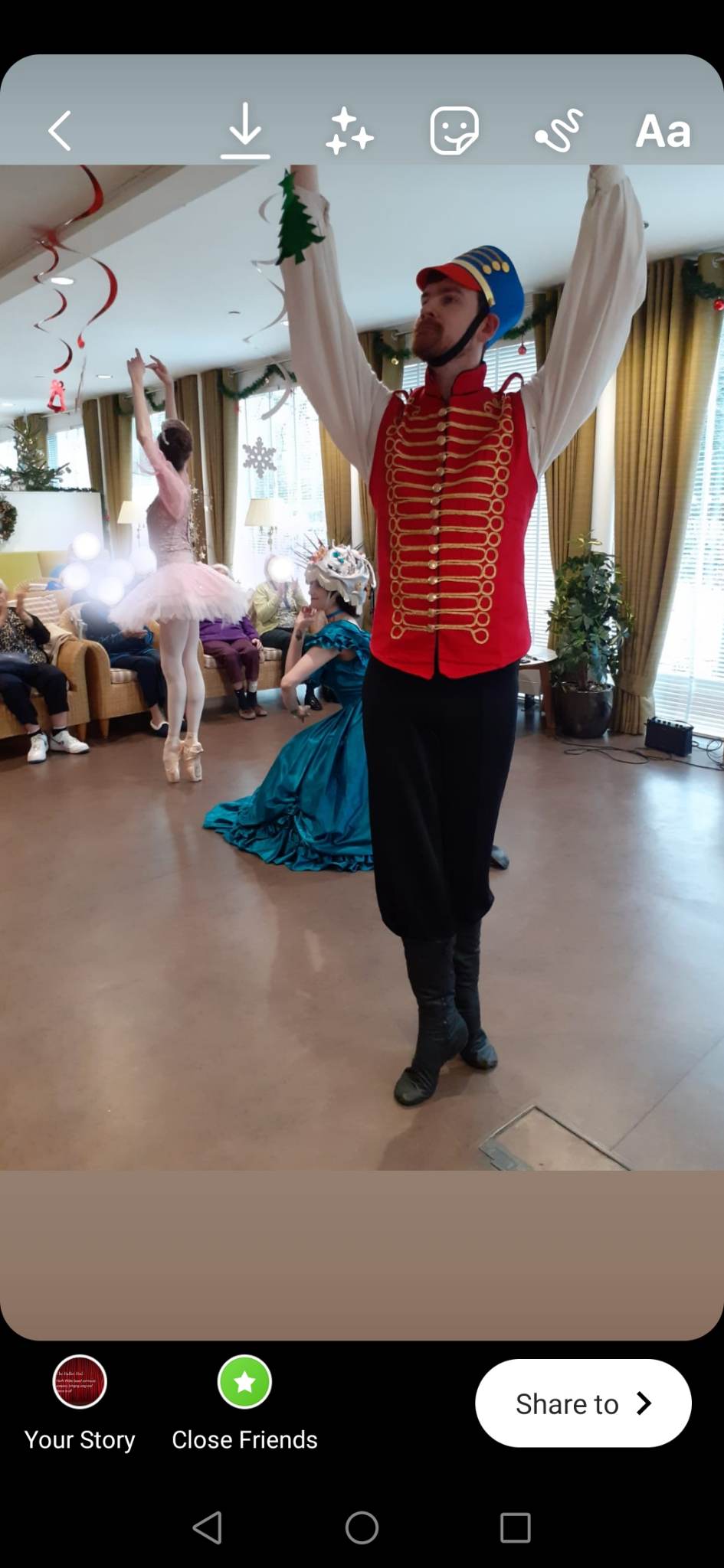
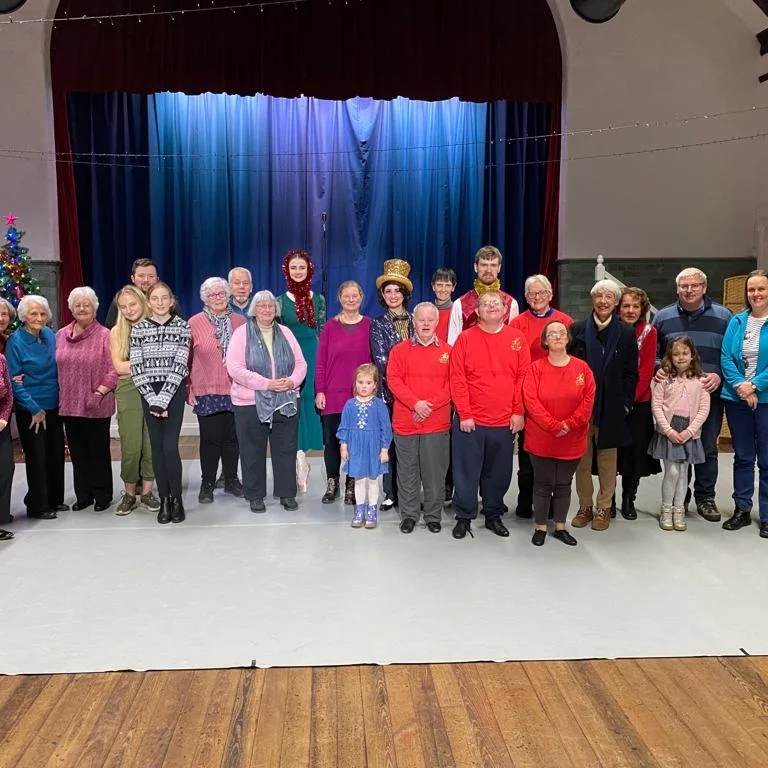
Then I travelled to Wales to work with The Ballet Pod. The family business which has now been going for 15 years and has given local performances every year over this time. We had a bookshop event, a community gala performance, a performance in a hospital and a performance in a care home.

In the middle of this was the submission deadline for my essay. It was crazy and there was little sleep that went on to be completely honest!

Yet it has been extremely rewarding. I worked for 15 days straight and am now taking a much needed rest.

But I want to reflect a little on some of the most significant moments and realisations from the last few weeks.

I first started performing with The Ballet Pod when I was 12 years old although it began unofficially when I was 10. Now as I look back at that time I realise how incredibly special it was to have that opportunity. It is very unusual t have a family business of entertainers and this has been very special to grow up with but also brought many challenges with it. We work together which means I have always found it very hard to shut down from work at the end of the day. It is challenging to ensure you keep the same respect for those you are so close to as you would any other colleague. It is difficult to get the tone of voice right, not too formal, not too familiar. But performing alongside my siblings also means that there can be total connection as we know each other so well.

However, the biggest realisation I have had has been that I was under a huge amount of pressure from a very young age and I did not have the skills to cope with that pressure. From the age of 14 I was teaching classes to myself, my siblings and later other children. I was in charge of costume organisation and inventories. Made all the headdresses for the company. Alongside this I was still taking my exams and doing academics. It was a lot and there were many lessons learned through that time. On returning this Christmas my duties were extended further due to staff shortages for various reasons. My responsibilities include teaching company class, teaching class and rehearsal and setting choreography for the children participating in our performance, sewing and creating costumes, fitting them, creating headdresses and sorting programming and administration and social media marketing. Rolling out, rolling up and carrying dance floor, writing out music cues and sending them through to the sound crew. Negotiating lighting and simple set up. rehearsal and performance scheduling. On top of this I have to get up and dance full pas de deuxs, solos and group dances, quick changes between each.

When I look at all this I realise that it is actually a huge amount but somehow when doing it I just get on with it! However I am now feeling that I cannot do the same level of work next year as it is a recipe for burnout. I feel that I need to take on someone else and delegate work I am going to be able to maintain my health and my dancing over the coming years. It just does not feel sustainable.


However, after 15 years working with The Ballet Pod I feel like I have come full circle and realised that the smallest most unlikely settings are where the biggest impacts can be made.

As I danced for those people in hospital I think of how much I love giving to those who are suffering. It is possible that this is because I am trying to make sense of a life of passed traumas. But I feel so strongly called to be of service.

This was the first hospital performance I had done but I felt strangely at ease within the setting. I danced well despite a concrete floor and an unconventional space.

One gentlemen became emotional during the Nutcracker pas de deux, perhaps overwhelmed by the music and the dance. But it was so special to see that later, after we had distributed our 'peace, love and hope' Christmas decorations, he was holding his decoration and looking at it intently then held it up to the crown of his head as if connecting to some spiritual force. 

Seeing people who were unwell and seeing their faces light up as I passed them was so special.

Also seeing the genuine emotion of the nurses. One of them was still becoming emotional thinking about it as we left.

For me, these are the moments I dance for. These are times I will cherish and always remember.

The child who takes your hand following a performance in a book shop

The patient's smile as you dance for them.

The audience member who wants to hug you following a performance

I would say these are the highlights of my career to date and I am proud of those highlights.

Dancing at The Linbury Theatre at The Opera House was special but I would say the moments of connection to people who would not otherwise access dance are the most treasured moments in my life.


Please note I have received consent to share these images publicly


The Essay

 As I reflect on the enlightening session last week with Peter Thomas in which Peter was exploring what defines an essay, I am inspired to s...